
SEO, GEO, and Browser APIs as one visibility stack
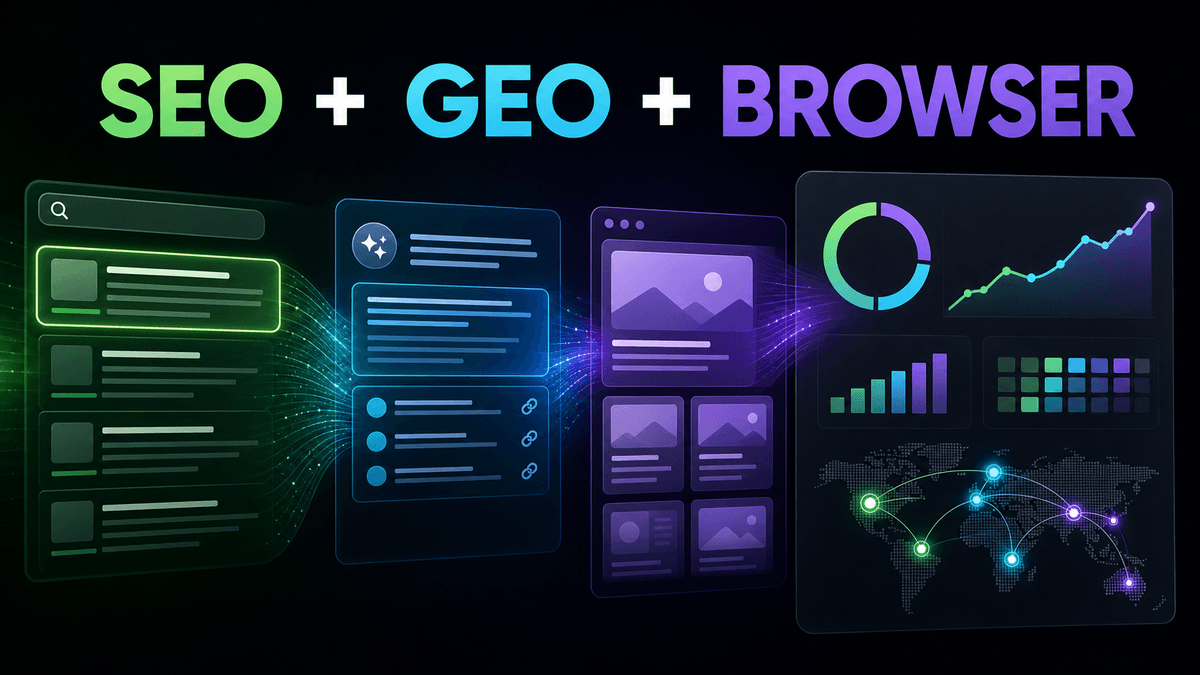

How UnifAPI combines live SEO records, GEO answer visibility, and rendered Browser reads into one evidence stack for marketing Agents.
In short: SEO records show where pages rank, GEO records show where brands and domains appear in AI answers, and Browser records show what the pages actually render. Together they make a stronger Agent workflow than any layer alone.
Search visibility work now has at least three surfaces. Classic organic search still matters. AI answers and citations now matter. The actual rendered page still matters because both humans and agents need to know what the page says.
UnifAPI treats these as one visibility stack:
- SEO API for live SERP, keyword, competitor, and backlink records.
- GEO API for AI answers, mentions, citations, and AI search volume.
- Browser API for rendered Markdown, HTML, screenshots, and links.
The stack is built for Agents, not just dashboards.
The core workflow
Start with a domain, competitor set, and prompt or keyword set.
| Step | API layer | Question |
|---|---|---|
| Pull classic search | SEO | Who ranks, which features appear, and where is the target visible? |
| Pull AI answer visibility | GEO | Is the brand or domain mentioned or cited in AI answers? |
| Read winning pages | Browser | What do cited or ranking pages actually say? |
| Compare gaps | SEO + GEO + Browser | Is the gap ranking, citation, content, authority, or clarity? |
| Recommend changes | Agent Skill | What should the operator do next? |
The output should be a visibility memo. It should not be a pile of JSON.
A copyable run prompt
Audit visibility for example.com against competitor.com for these prompts: "best public data API for agents", "MCP server for marketing agents", and "SEO API for Claude". Use UnifAPI SEO records for classic SERP rank, GEO records for AI answer mentions and citations, and Browser Markdown for the target page plus the top cited competitor page. Return a table of SEO rank, GEO citation, rendered-page gap, and recommended fix. Cite records and label inferred recommendations.
This prompt creates a bounded run. It is broad enough to connect the layers, but narrow enough to keep cost and evidence under control.
How to diagnose the gap
| Pattern | Likely interpretation | Next step |
|---|---|---|
| Competitor ranks and is cited | Strong source and answer alignment | Inspect competitor page and build a direct alternative |
| Target ranks but is not cited | Citation or clarity gap | Improve answer-ready sections and source signals |
| Target is cited but ranks poorly | AI answer signal stronger than classic SEO | Strengthen organic page and internal links |
| Neither target nor competitor is cited | Prompt may be open | Create the clearest answer page and supporting sources |
| Target page renders poorly | Technical or content accessibility issue | Fix rendered content, links, headings, and schema |
The point is not to overfit one run. The point is to decide which surface needs work.
Why Browser is the bridge
SEO and GEO can tell the Agent which pages matter. Browser tells it what those pages contain.
If a competitor wins an AI citation, the Agent can read the cited page. If a target page ranks lower than expected, the Agent can inspect the rendered copy and links. If a JavaScript-heavy page hides key text from a basic fetch, Browser Markdown gives the assistant something closer to what a user sees.
That bridge makes recommendations concrete:
| Weak recommendation | Evidence-backed recommendation |
|---|---|
| Improve content | Add a comparison section answering the exact prompt competitors win |
| Build authority | Add source-backed definitions and link to primary evidence |
| Fix technical SEO | Render the FAQ server-side and expose crawlable internal links |
| Improve GEO | Create an answer-ready page with named use cases and citations |
Cost control
The stack can be cheap for small runs and expensive if left unbounded. Agents should plan before large jobs.
| Scope | Suggested behavior |
|---|---|
| 3 prompts, 1 domain, 1 competitor | Run directly |
| 20 prompts, 5 competitors | Estimate records and ask for a cap |
| Weekly monitoring | Create a repeatable prompt set and diff output |
| Full-site audit | Break into keyword, GEO, backlink, and page batches |
Good Skills include these cost gates so a single "audit everything" prompt does not silently turn into dozens of paid calls.
Primary references
This stack should stay grounded in official search documentation. Use Google's SEO Starter Guide for classic search basics, AI features and your website and the generative AI optimization guide for AI-search framing, JavaScript SEO basics for rendered-page checks, and Schema.org BlogPosting when validating blog/article entity markup.
What to read next
SEO Agent live rank audits - the classic search side of the stack.
AI Visibility Agent for GEO - the answer-engine side.
Browser API for agent web reading - the rendered-page side.
Free Google AI Overview checker - check the answer-engine side of any query, free.
Google AI Overviews - the answer surface this stack measures, defined in depth.