
Competitive Intelligence Agent: turn public signals into a launch brief
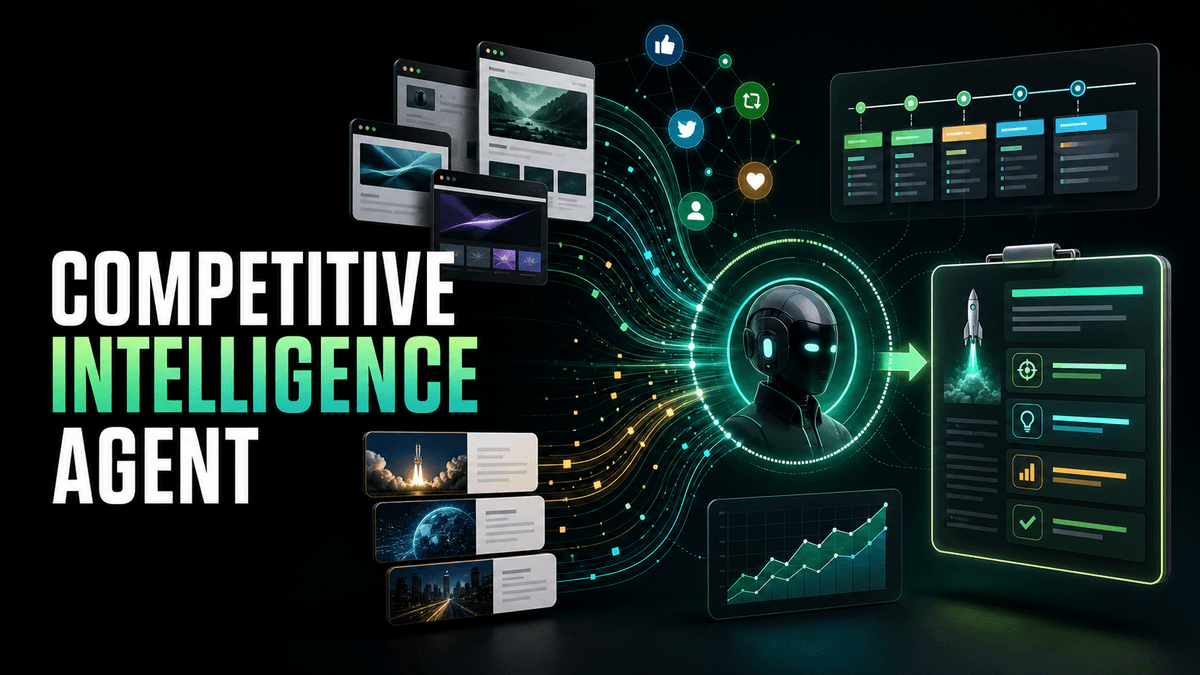

How the Competitive Intelligence Agent turns SEO, browser, social, LinkedIn, Reddit, Hacker News and news records into cited competitor briefs.
In short: The Competitive Intelligence Agent reads public launch, positioning, social, hiring, search, and news signals, then turns them into a cited brief. It is research, not espionage.
Competitive intelligence is usually glue work. Someone checks a competitor's site, launch posts, founder accounts, LinkedIn page, YouTube demos, Reddit mentions, Hacker News threads, news coverage, and search visibility. Then they try to summarize what changed.
That is exactly the kind of public-data workflow an Agent can run well.
What the Agent reads
| Source | Signal |
|---|---|
| Browser | Rendered competitor pages, pricing, docs, changelog, links |
| SEO | Ranking pages, keyword positions, competitor domains |
| X, Threads, Reddit, Hacker News | Launch reactions, customer language, founder posts, developer response |
| Company page, hiring, public posts, people signals | |
| YouTube | Demos, tutorials, channel activity |
| News | Announcements, coverage, and market context |
The value is not one source. The value is correlating public signals across sources and citing the evidence.
A copyable run prompt
Build a competitor launch brief for competitor.com. Use UnifAPI MCP to read the homepage, pricing page, docs or changelog with Browser Markdown and Links, then pull public social and news signals from X, LinkedIn, YouTube, Reddit, Hacker News, and news where available. Add SEO evidence for ranked pages and competitor keywords. Return a timeline, positioning changes, audience reaction, likely ICP, product gaps, and recommended response. Cite every record and label uncertain inferences.
This prompt sets a bounded task. It avoids the common "research this company" sprawl.
The launch brief shape
| Section | What it should include |
|---|---|
| What changed | Product, pricing, positioning, docs, or launch narrative |
| Timeline | Public signals ordered by date |
| Channel map | Where the launch appeared and where it got traction |
| Customer language | Repeated phrases, objections, praise, or confusion |
| SEO impact | Ranking pages, competitor keywords, search surfaces |
| Product read | What the public evidence suggests, with confidence |
| Recommended response | Content, positioning, sales enablement, or monitoring moves |
A good brief is explicit about uncertainty. Public signals can show what a competitor says and what the market publicly reacts to. They cannot reveal private revenue, roadmap, customer contracts, or internal strategy.
Why Browser matters here
Competitor pages are often dynamic. Pricing tables, comparison sections, changelogs, and docs navigation may be rendered client-side. Browser Markdown and Links let the Agent read what the page actually shows and how it routes users.
That enables concrete findings:
| Observed evidence | Better interpretation |
|---|---|
| New pricing tier appears on rendered page | Competitor may be moving upmarket |
| Docs links emphasize one integration | Launch likely targets that ecosystem |
| Comparison page names your category | Competitor is entering your positioning space |
| Changelog links to migration guide | Feature may be production-ready, not just announced |
The Agent should still avoid overclaiming. "May indicate" is sometimes the honest wording.
How Skills keep the run focused
The competitor-launch-monitor Skill watches for public changes and launch signals. The competitor-profiling Skill builds a deeper profile. Platform Data Skills tell the Agent how to read LinkedIn, Reddit, X, YouTube, Hacker News, or Threads without guessing operation names.
Those Skills are important because competitor research can become endless. The runbook should specify:
- Which competitor is in scope.
- Which surfaces to read first.
- Which time window matters.
- Which output format to return.
- Which claims require citations.
What not to do
Do not use the Agent to access private systems, scrape behind logins, impersonate users, or infer confidential information. UnifAPI is a public-data layer. The useful product is faster, better-cited public research.
Do not mistake noise for signal either. One annoyed comment is not a market shift. A launch claim without customer reaction is a claim, not traction. A pricing page change may be an experiment, not a strategy.
What to read next
Browser API for agent web reading - the rendered-page layer behind competitor research.
Platform Agents and Data Skills - the source-specific read paths.
Browse the Competitive Intelligence Agent - open the live Agent page.