
Nitter alternatives in 2026: what still works for scripts and agents, free and paid

Updated
We curl-tested Nitter instances, viewer sites, link-preview APIs and X's endpoints in October 2026: what still works free, and when to pay for MCP or an API.
In short: Nitter as a public service is over. On October 7, 2026,
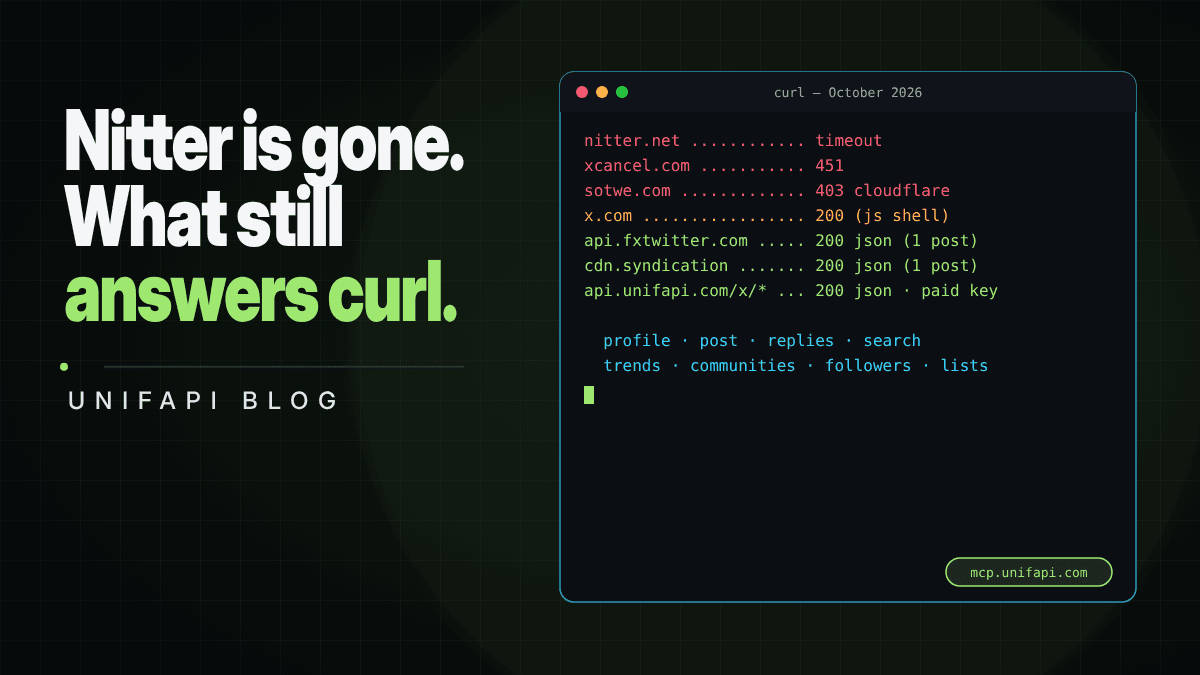
nitter.nettimed out,nitter.privacydev.netrefused the connection, andxcancel.comanswered HTTP 451 (blocked for legal reasons). The viewer sites that replaced it in search results, sotwe and twstalker, answer a Cloudflare challenge to anything that is not a browser. What still works for a script, free: FxTwitter and vxTwitter for one post or one user, and X's syndication endpoint for one post. Past one post or one profile (replies, search, timelines, media, followers, trends), nothing we tested is both free and readable by a script; UnifAPI covers that ground as the paid option, with an MCP server for agents and an X API for code, priced per returned record. UnifAPI's X viewer pages stay free for a person in a browser, with no login or account and a per-visitor rate limit. Nothing free gives you a throughput guarantee.
Nitter was the answer to "read Twitter without an account" for five years: a privacy front end that rendered profiles, threads, and search as plain HTML. That made it the default for scripts and, later, for the first AI agents, which could curl a Nitter URL and read the result. In early 2024 X closed the guest-account path Nitter depended on, and the instances have been dying since. The name still ranks, so people keep landing on dead instances and on viewer sites that behave worse than the thing they replaced.
This is what we found when we tested the field with the tools an agent actually has: curl, a default User-Agent, no cookies.
The test
Two requests per target: NASA's profile, and one public post (x.com/NASA/status/2107237881668313108). We recorded the HTTP status, the content type, and whether a program could read the post's text and like count from the body without running JavaScript.
| Target | Profile | Post | Readable by a script | Notes |
|---|---|---|---|---|
nitter.net | timeout | timeout | No | No response in 7 s |
nitter.privacydev.net | refused | refused | No | Connection refused |
xcancel.com | 451 | 451 | No | "Unavailable for legal reasons" |
sotwe.com | 403 | 403 | No | Cloudflare "Just a moment…" challenge |
twstalker.com | 403 | 403 | No | Cloudflare challenge |
x.com | 200 | 200 | No | 147 KB HTML shell; data loads via JavaScript |
api.fxtwitter.com | 200 JSON | 200 JSON | Yes | Single user, single post; no search or replies |
api.vxtwitter.com | n/a | 200 JSON | Yes | Single post |
cdn.syndication.twimg.com/tweet-result | n/a | 200 JSON | Yes | Undocumented; single post |
publish.twitter.com/oembed | n/a | 200 JSON | HTML inside JSON | Embed markup, no metrics |
api.unifapi.com/x/* | 200 JSON | 200 JSON | Yes, with a paid key | Billed per record; plus media, replies, search, trends, communities, followers |
We updated the UnifAPI row on October 17, 2026, when UnifAPI moved scripted X access to its paid MCP server and API; every other row is still the October 7 result.
Three kinds of failure, and they are worth telling apart.
Gone. The Nitter instances. There is no fix; the upstream access they used no longer exists. Any code or prompt that still builds a nitter.net/<handle> URL should be deleted.
Walled. sotwe and twstalker work in a browser and serve a Cloudflare challenge to everything else. For a person they are fine. For a script they are a 403, and a headless browser that passes the challenge today may not tomorrow.
Shelled. x.com itself returns a page with no content in it. Rendering it needs a real browser, a login wall appears quickly, and it is against the terms.
What works, and for what
FxTwitter and vxTwitter
The link-preview APIs. api.fxtwitter.com/<user>/status/<id> returns a JSON object with text, metrics, media, and the quoted post; api.fxtwitter.com/<user> returns the profile's counts and bio. vxTwitter does the same for posts with a flatter shape. Both are free, keyless, community-run, and built for one post at a time. They have no search, no replies, no timeline, and no stated rate limit. For a Discord bot that unfurls links, they are the right tool. For a workflow, they are the first step with no second.
X's own endpoints
cdn.syndication.twimg.com/tweet-result?id=<id>&token=x returns a post as JSON because that is what X's embed widget consumes. It is official in the sense that X serves it and undocumented in every other sense; the token parameter's rules have changed before. publish.twitter.com/oembed is documented but returns embed HTML, not data. Use the first as a cross-check and never the second for data.
UnifAPI: free viewer pages, paid MCP and X API
UnifAPI is built for the rest of the table: everything an agent asks for after the first post. It comes in two forms, and only the one for people is free.
In a browser, free. The X viewer pages need no login and no account, and they are rate-limited per visitor: 20 lookups per 10 minutes, with a search counting as two. /tools/twitter-viewer routes a handle, a link, a hashtag, or a query to the right viewer: profiles, posts, media, replies, search, trends, communities, and followers. Each takes a ?q= deep link, such as /tools/x-reply-viewer?q=2107237881668313108, and each has a Connect button that switches the page to pay as you go, with no cap. They are pages for people, not an API.
For agents, the MCP server (paid). Add https://mcp.unifapi.com to the client and sign in with OAuth when it asks; there is no key to paste. The agent gets three tools, list_operations, get_operation, and call_api, and calls spend Workspace Credits, pay as you go. Setup for Claude, ChatGPT, Cursor, Codex, and other clients is on the MCP page. NASA's recent posts with media are one call:
{
  "path": "/x/tweets/search/recent",
  "method": "GET",
  "query": { "query": "from:nasa filter:media", "max_results": 20 }
}
For code, the X API (paid). The same operations over HTTP at https://api.unifapi.com, with a Workspace API key as a Bearer token. The X / Twitter API reference lists every operation:
H="Authorization: Bearer $UNIFAPI_API_KEY"
curl -s -H "$H" "https://api.unifapi.com/x/users/by/username/nasa"
curl -s -H "$H" "https://api.unifapi.com/x/tweets/2107237881668313108"
curl -s -H "$H" "https://api.unifapi.com/x/tweets/search/recent?query=conversation_id%3A2107237881668313108&max_results=20"
curl -s -H "$H" "https://api.unifapi.com/x/tweets/search/recent?query=from%3Anasa%20filter%3Amedia&max_results=20"
curl -s -H "$H" "https://api.unifapi.com/x/trends/by/woeid/23424856?max_trends=20"
The third call reads the replies to the test post through X's conversation_id: operator; the last one is Japan's trends (WOEID 23424856).
Every response is one envelope: data (an object for one item, an array for a list), pagination on lists (pass next_cursor back as pagination_token for the next page), and billing with credits_charged and balance_remaining. Fields follow X API v2, so a post's likes are public_metrics.like_count and its author is author_id, with the profile under author. Errors are {"error": {"type": "…", "message": "…"}}, with unauthorized (401) for a missing key, insufficient_credits (402) carrying a top-up link, and rate_limited (429). Responses carry RateLimit-* and X-RateLimit-* headers, and the default limit is 60 requests per minute per key.
The price is 1 credit per returned record, with a minimum of 1 per call, and a credit costs $0.001. The profile above is 1 credit, the post is 1, and a full 20-post search page is 20 credits ($0.02). There is no subscription: sign in, top up, and create a key; the Connect button on any viewer page does the same in one flow. The balance never goes negative: a list call returns fewer records instead and sets truncated_due_to_balance.
If you used the old free endpoints under /tools/x/: since October 17, 2026, those URLs answer scripts and agents with HTTP 402, and the body names the MCP server and the paid operation that replaces each lookup. The viewer pages stay free in a browser. Through the MCP server at https://mcp.unifapi.com or the X API, a call bills 1 credit ($0.001) per returned record and at least 1 credit, so a profile with its 10 latest posts costs 11 credits ($0.011).
Choosing
| You need | Use |
|---|---|
| One post unfurled in a chat app | FxTwitter |
| One post or one profile as JSON from a script, free | FxTwitter, or vxTwitter for a post |
| A sanity check that a post's text is what X serves | The syndication endpoint |
| A page a person opens | Any viewer, including the free /tools/twitter-viewer |
| Replies, search, timelines, media, followers or trends, from an agent | The UnifAPI MCP server, paid per record |
| The same from code, with a documented rate limit | The UnifAPI X API with a key, paid per record |
If it has to be free and scripted, stay inside what FxTwitter, vxTwitter, and the syndication endpoint do: one post or one profile at a time. If you need search, replies, timelines, or an agent that runs the lookups itself, the MCP server or the X API is the paid route.
FAQ
Is Nitter dead?
As a public service, yes. The instances that answered on October 7, 2026 answered with a timeout, a refused connection, or HTTP 451. Self-hosting still works for people who have their own X session cookies to feed it, which is not something an agent should rely on.
What is the best Nitter alternative for scripts?
If it has to be free: FxTwitter for one post or one profile, with vxTwitter or X's syndication endpoint as a second source for a post. None of them has search, replies, or timelines. For those, or for an agent that runs the lookups itself, the paid option is UnifAPI: the MCP server for agents and the X API for code, at 1 credit ($0.001) per returned record with no subscription.
What is xcancel?
A Nitter instance that was, until recently, the most reliable public one. It now returns HTTP 451 to every request.
Can I use sotwe or twstalker from a script?
Not without passing a Cloudflare browser challenge, which is both fragile and against the spirit of the challenge. They are browser tools.