
Keyword search volume checker workflow: decide what to write next
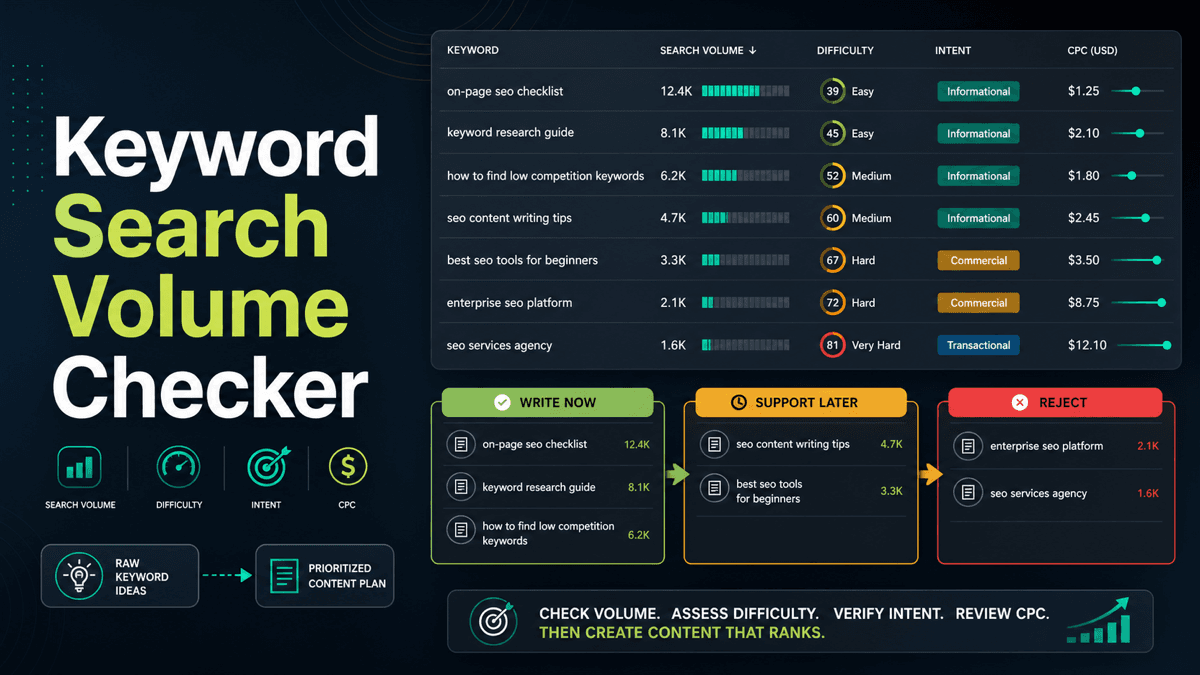

A practical workflow for checking keyword search volume, difficulty, CPC, and intent before turning a keyword list into a content brief.
In short: search volume tells you whether demand exists. Difficulty, intent, CPC, and SERP shape tell you whether the keyword deserves a page.
A keyword list is not a content plan. It is a pile of possible bets. The job of a keyword search volume checker is to turn that pile into a smaller set of terms worth briefing, tracking, or rejecting.
The biggest mistake is sorting only by volume. High-volume keywords are often too broad, too hard, or too far from the product. A useful workflow scores the keyword and the page type together.
The four-metric pass
Check every candidate keyword against four signals.
| Metric | What it answers | How to use it |
|---|---|---|
| Monthly search volume | Is there measurable demand? | Use it to avoid writing only for phrases nobody searches. |
| Keyword difficulty | Can this site realistically rank? | Use it to separate near-term pages from authority-building bets. |
| Search intent | What kind of page does the query want? | Match informational terms to guides and commercial terms to product or comparison pages. |
| CPC / competition | Is there business value? | A nonzero CPC often means the term has buyer or advertiser intent. |
The best early SEO opportunities usually sit in the middle: enough volume to matter, low or moderate difficulty, clear intent, and direct product relevance.
A scoring rubric that works
For each keyword, assign one of three actions.
| Action | Pattern | Example page type |
|---|---|---|
| Write now | Clear intent, reachable difficulty, product relevance | Tool page, glossary, cookbook, comparison |
| Support later | Good demand but too broad or competitive | Cluster hub, linkable research asset |
| Reject | Irrelevant, ambiguous, or low-value intent | No page, or mention only inside a broader guide |
This keeps the content calendar from becoming a list of search terms. The output should be a brief with a target page type, internal links, and a success metric.
Do not stop at volume
After the volume check, run two follow-ups before writing.
- Use the keyword ideas generator to find variants you may have missed.
- Use the SERP checker to see what kind of pages already win.
If the SERP is full of calculators and free tools, a blog post is probably the wrong answer. If the SERP is full of tutorials, a product page may need a supporting guide. If an AI answer appears, use the AI Overview checker to inspect cited sources before rewriting.
From a one-off check to an agent workflow
Here is a bounded prompt for an SEO or content agent:
Check search volume, difficulty, intent, and CPC for this keyword list. Group terms into "write now," "support later," and "reject." For each "write now" term, recommend the page type, primary angle, internal links, and one query to track after publishing.
That prompt gives the agent permission to prioritize instead of simply expanding the list.
What to read next
Keyword search volume checker - score up to 10 keywords in the browser.
SEO Agent live rank audits - turn keyword checks into repeatable rank monitoring.
Content Strategy Agent - build topics from search, social, video, and news demand.