
Instagram former username checker: verify account history before outreach
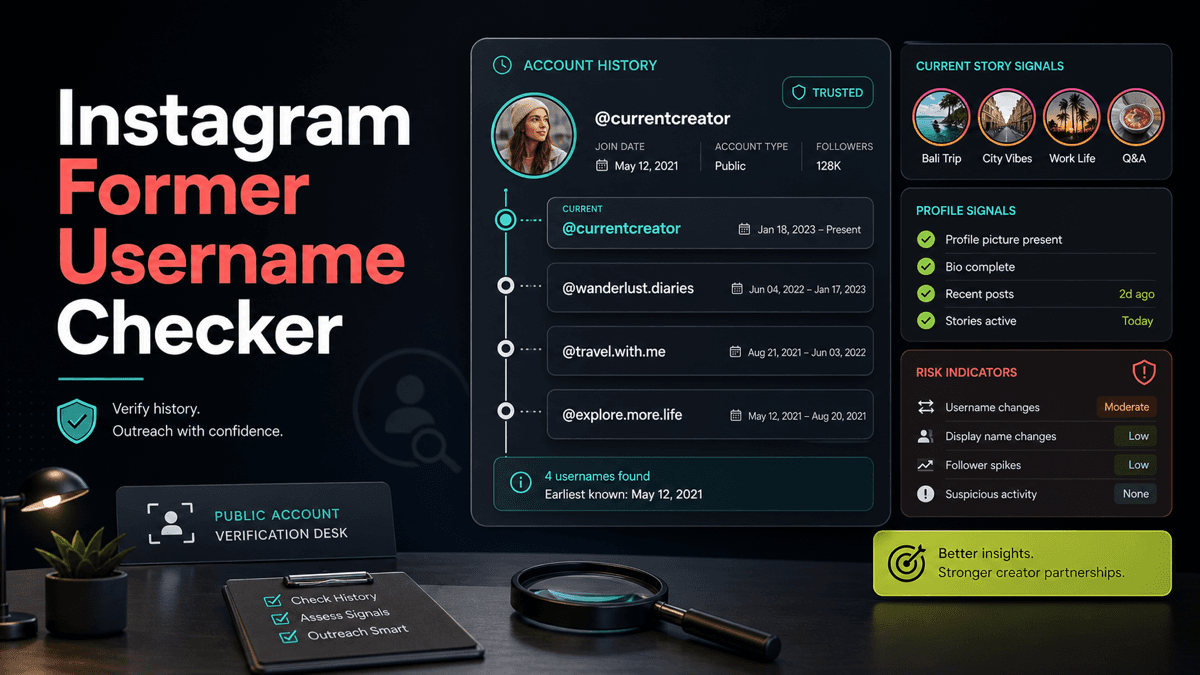

How to use Instagram former usernames, public profile data, and active stories to verify account history before creator outreach or competitor research.
In short: former usernames are a trust signal. They do not prove fraud, but they tell you when an Instagram account has changed identity and deserves a closer look.
Instagram research often starts with followers, posts, and engagement. Account history belongs in the same first pass, especially when you are evaluating creators, brand partners, or accounts that changed niches.
The Instagram former usernames endpoint reads the public account-history surface behind "About This Account." Pair it with the Instagram story viewer and Instagram profile analyzer to see both history and current behavior.
When to check former usernames
You do not need former usernames for every casual profile visit. You do need them when the account will influence a decision.
| Scenario | Why former usernames help |
|---|---|
| Creator outreach | A history of unrelated names can signal an account flip or changed niche. |
| Brand safety review | Name changes can reveal whether current content matches the account's older audience. |
| Competitor monitoring | A renamed account may explain sudden changes in follower quality or story style. |
| Scam and impersonation checks | Recent identity changes are not proof, but they are a cue to verify more evidence. |
| Acquisition or partnership diligence | Account age and history reduce reliance on a single screenshot of follower count. |
The right interpretation is cautious: treat former usernames as one evidence point, not a verdict.
A practical account-history workflow
Start with the account identity, then move into live behavior.
- Resolve the username and confirm the public profile.
- Check former usernames and the account join date when available.
- Review recent posts for topic consistency.
- View active stories to see what the account is promoting now.
- Compare engagement rate against follower count before deciding to reach out.
That order prevents a common mistake: overreacting to a name change without checking whether the account's current content and audience still fit the job.
What former usernames can and cannot prove
Former usernames are useful because they are public account-history metadata. They are limited because they do not explain the reason for the change.
| Signal | Stronger interpretation | Weaker interpretation |
|---|---|---|
| Many unrelated former usernames | The account may have changed niche or ownership. | The creator may simply have rebranded several times. |
| Recent name change plus new promotion style | Worth a brand-safety review. | Not enough to call the account fake. |
| No former usernames returned | Lower history risk from this source. | Not proof that nothing changed elsewhere. |
| Old join date plus consistent niche | More confidence in account continuity. | Still check engagement and current posts. |
For an agent, the useful output is a confidence note: "history looks consistent," "history is unclear," or "history suggests rebrand/account-flip risk."
Turn it into an agent prompt
Use a bounded prompt when you have a shortlist:
Review these Instagram creator handles before outreach. For each account, fetch public profile data, former usernames, recent posts, and active stories when available. Return account-history risk, current niche, engagement quality, promotion signals, and whether the account is safe to move into the next vetting stage.
The prompt keeps the agent read-only. It gathers evidence; the operator still decides whether to contact the creator.
What to read next
Instagram former usernames endpoint - the public account-history call.
Instagram story viewer - inspect active public stories.
Influencer Marketing Agent - run creator vetting from public records.