
UnifAPI vs Semrush: per-record SEO API vs. all-in-one platform
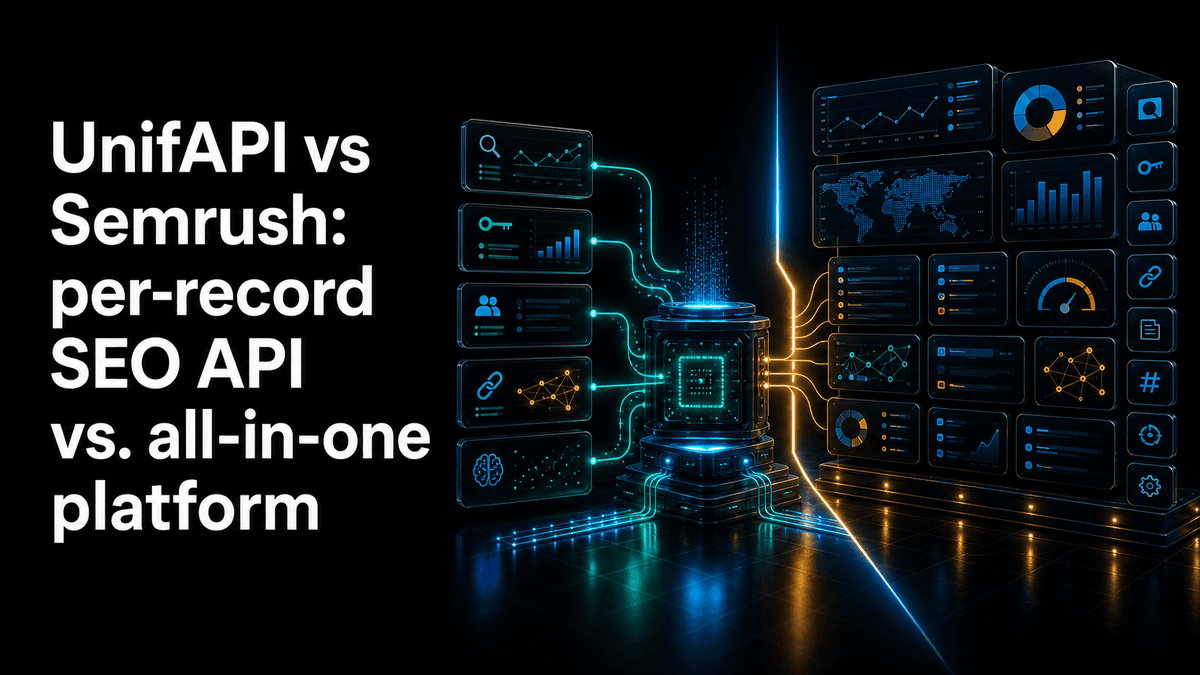

Semrush is an all-in-one marketing platform for human teams. UnifAPI exposes live SERP, keyword, competitor, backlink, and AI-visibility records as a per-record API for agents. Here is when each one wins.
In short: This article is for readers comparing Semrush's all-in-one marketing platform with an agent-native SEO API, and reframes the choice as a seat-based suite versus per-record SERP, keyword, competitor, and AI-visibility records.
Semrush is an all-in-one marketing platform: SEO, paid search, content, competitive analysis, and social, bundled into one large dashboard with projects, reports, and seats. UnifAPI is the opposite shape — a narrow, agent-native API that returns the underlying SERP, keyword, competitor, backlink, and AI-visibility records, billed per record. If a marketing team is going to operate a workspace, Semrush is built for that. If an agent needs SEO data on demand, the suite is more than the job requires.
Quick decision table
| Question | Pick Semrush when... | Pick UnifAPI when... |
|---|---|---|
| Who uses it? | A marketing team in a dashboard | An agent or backend fetching records |
| How wide is the scope? | SEO + PPC + content + social in one suite | SEO/SERP/keyword/backlink + AI visibility as records |
| What is delivered? | Projects, reports, position tracking, alerts | Normalized JSON an agent can cite and combine |
| How is it priced? | Subscription tiers per seat, with limits | $0.001 credits, OpenAPI-published operation minimums |
| How does it connect? | Web app, with API access on higher tiers | One MCP server, plus HTTP when productized |
What Semrush optimizes for
Semrush optimizes for breadth in one place. A marketer can research keywords, audit a site, track positions, study competitors, plan content, and look at advertising data without leaving the platform. For a team whose whole job is marketing, that consolidation is valuable: fewer tools, shared projects, and reporting designed to be read by people and shown to clients.
The cost of breadth is that the platform is built around seats and projects, and its API is gated to higher tiers and priced in its own units. When all you need is to pipe a slice of SEO data into an agent, you end up buying — and learning — a marketing suite to get at a few endpoints.
What UnifAPI optimizes for
UnifAPI optimizes for agent ergonomics in a narrow lane: the SEO and AI-visibility records an agent needs to answer a question. Live organic and AI SERP checks return ranked elements, target visibility, competitor domains, SERP features, and cited sources. Keyword and competitor research return search volume, keyword ideas, ranked keywords, competing domains, and keyword intersection. Backlink operations return backlinks, referring domains, and anchors. GEO operations return AI-answer citations and LLM mentions.
Because every operation shares one envelope, an agent can join SEO records with social, news, and maps records in a single brief without re-integrating auth, pagination, billing, or error handling per source.
Pricing: subscription suite vs. returned records
Semrush is sold as subscription tiers, with seat limits, project limits, and API access reserved for higher plans and priced separately. That works for a team using the product daily. It is a poor fit when an automated workflow needs occasional SEO data, because the bill is anchored to a platform subscription rather than to the records you consume.
UnifAPI charges for the data: most records are one $0.001 credit, higher-cost SEO operations publish their minimum credits from OpenAPI, and there are no seats. The 500-credit trial is enough to test the shape of a few SEO runs before topping up a pay-as-you-go balance.
| Example workflow | Semrush-style concern | UnifAPI-style concern |
|---|---|---|
| Pull keyword ideas for a topic | Plan tier and API availability | Records returned per keyword call |
| Track a domain's ranked keywords | Seat and project limits | Records returned, with published minimums |
| Add AI-answer visibility | Newer feature, if on your tier | GEO records in the same envelope |
Where UnifAPI begins: the agent loop
Most agents do not want a marketing dashboard; they want to answer a question and move on. 'What does the SERP look like for these ten queries,' 'which keywords does this competitor rank for,' 'who links to this domain,' and 'are we cited in AI answers' are all per-record questions. UnifAPI lets the agent discover the operation, fetch the rows, and synthesize — then re-run the same operation tomorrow without a standing project.
That loop is also cheaper to reason about. The agent can bound a run to the top results, inspect the record count, and decide whether deeper analysis is worth the spend, instead of paying a flat platform fee whether it queries once or a thousand times.
AI visibility is first-class, not an add-on
Marketing suites are racing to bolt generative-engine visibility onto existing dashboards. UnifAPI ships it as live API records from day one: AI Mode answers with cited sources, LLM-mention tracking across ChatGPT and AI search engines, and AI keyword search volume. For an agent building a visibility report, classic SERP rank and AI-answer citation come back as the same kind of record.
When Semrush is still the right call
Pick Semrush when a marketing team needs an all-in-one workspace: SEO plus PPC plus content plus social, with projects, position tracking, audits, and client-ready reporting. If humans are doing the marketing work in a UI and value having every channel in one login, a broad suite wins.
Semrush is also the better choice when you need its specific datasets and tooling — advertising research, content templates, and the long-running project history that a platform maintains for you.
When UnifAPI is the right call
Pick UnifAPI when an agent needs SEO and AI-visibility data as records, not a suite: live SERPs, keyword and competitor research, backlinks, and AI-answer citations returned in one envelope, billed per record, reachable through one MCP connector. Pick it when the SEO data is an input to a larger automated workflow rather than the daily workspace of a human team.
Start from the SEO API at unifapi.com/apis/seo, add AI visibility at unifapi.com/apis/geo, connect MCP at unifapi.com/mcp, and see per-record pricing at unifapi.com/pricing.
Using both
A team can keep Semrush as the marketing cockpit for people and use UnifAPI to feed agents the SEO and AI-visibility records they need for monitoring, enrichment, and cross-source briefs. They sit at different layers: one is where marketers work, the other is where agents read.
Sources checked
This comparison was refreshed on June 3, 2026 against UnifAPI's current SEO and GEO API surfaces and Semrush's publicly described all-in-one platform and tiered API model. It avoids quoting exact Semrush prices because plans and API limits change; it focuses on the durable difference between an all-in-one marketing suite and an agent-native per-record SEO API.
What to read next
UnifAPI vs Ahrefs - compares the SEO suite and backlink index in the same lane.
Per-record pricing - explains the pricing wedge against subscription tiers.
GEO API - shows the AI-visibility records that suites bolt on later.