
Why SKILL.md runbooks make marketing Agents repeatable
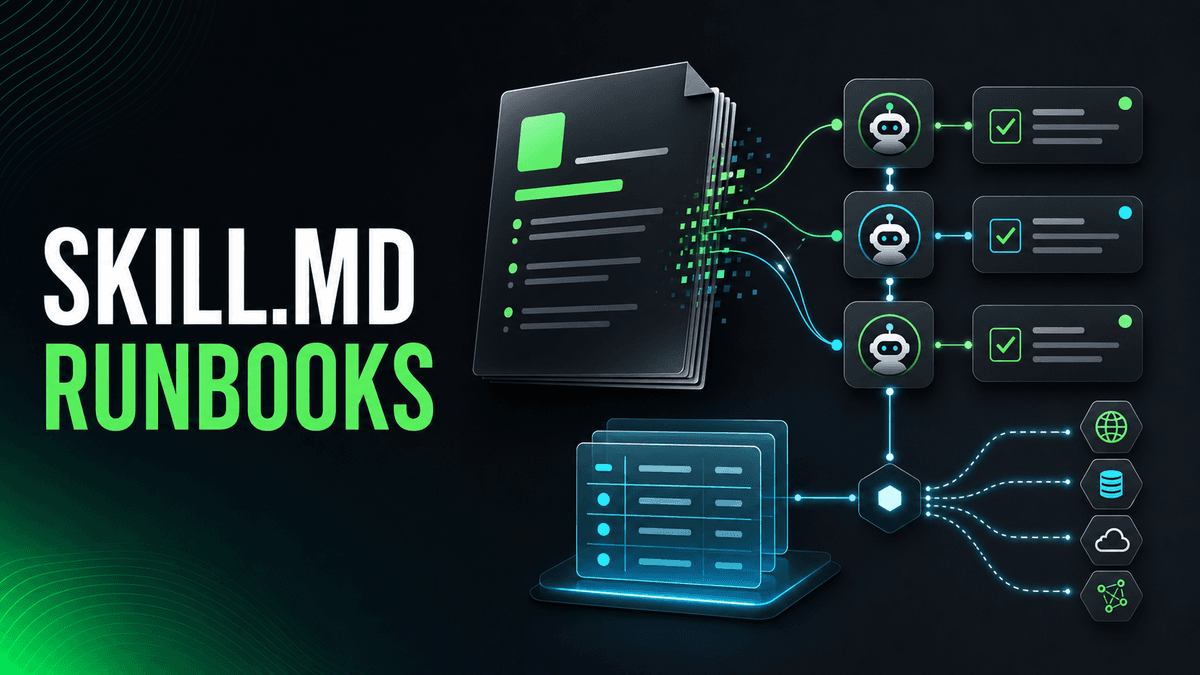

A practical guide to the Skill layer in UnifAPI: trigger phrases, data calls, output templates, confidence rules, and public-data boundaries.
In short: A Skill is the repeatable unit inside a UnifAPI Agent. It tells the assistant when to use the workflow, what data to fetch, how to structure the output, and where to stop.
Prompts are easy to write and hard to maintain. A useful marketing workflow needs more than one instruction. It needs triggers, input requirements, data-source choices, confidence rules, output templates, and limits.
That is why UnifAPI Agents are implemented as Skills.
What belongs in a Skill
| Skill part | What it does |
|---|---|
| Name and description | Helps the assistant route to the right workflow |
| When to use | Lists trigger phrases and user intents |
| Inputs | Tells the assistant what context to collect before calling data |
| Data calls | Names the UnifAPI operations or Data Skills to use |
| Workflow | Turns the job into steps |
| Output template | Prevents vague summaries |
| Confidence rules | Separates observed facts from inferred judgment |
| Boundaries | Keeps the Agent read-only and honest |
A Skill is strongest when it names one capability. keyword-research is a Skill. seo-audit is a Skill. ai-answer-gap is a Skill. "Do all marketing" is not.
Enhanced, Advice, and Data Skills
UnifAPI uses three Skill kinds:
| Skill kind | What it means | Example |
|---|---|---|
| Enhanced | A marketing capability that calls live public data | SEO audit, KOL pricing, AI visibility audit |
| Advice | Framework or judgment without a live call | Schema guidance, positioning frameworks |
| Data | A deterministic source guide owned by a Platform Agent | LinkedIn Data Skill, Reddit Data Skill |
This distinction keeps the product clear. Not every useful marketing Skill needs a live API call. But when a Skill makes a factual claim about public visibility, it should use records.
Why Skills should name operations
An assistant can discover operations through MCP, but discovery is not the whole workflow. A good Skill should still tell the assistant which data families matter for the job.
For example, an SEO audit Skill can say:
- Pull live SERP evidence for the target queries.
- Use keyword overview and history for demand context.
- Use Browser Markdown for the target page and top competitor pages.
- Return a fix plan with observed evidence and recommendations separated.
That is much better than: "Use the API if needed."
Output templates are part of the product
The output shape is where many agent workflows fail. Without a template, the assistant may return a pleasant summary that cannot be acted on.
A Skill should specify the artifact:
| Workflow | Useful artifact |
|---|---|
| KOL pricing | Ranked creator table with low/base/high ranges and confidence |
| GEO audit | Prompt-by-prompt citation and mention matrix |
| Local-pack scan | Query, rank, competitors, review count, and map position |
| Competitor profiling | Launch timeline, channels, claims, proof, and risks |
| Content strategy | Opportunity backlog with demand, source evidence, and fit |
Templates do not make the assistant robotic. They make the answer reviewable.
Confidence rules prevent fake certainty
Public data is powerful, but it is not omniscient. A Skill should make the assistant label:
| Label | Meaning |
|---|---|
| Observed | Directly read from a public record |
| Inferred | Deduced from several records |
| Assumed | Provided by the user or required to complete the analysis |
| Unknown | Not available from public data |
That matters in marketing workflows. A KOL pricing Skill can estimate a range, not a final quote. A GEO Skill can report visibility, not guarantee future inclusion. A local SEO Skill can audit listings, not edit them.
A short Skill quality checklist
Before publishing a Skill, ask:
- Does it map to one concrete job?
- Does the description include real trigger phrases?
- Does it specify required and optional inputs?
- Does it name the data sources or Data Skills to use?
- Does it include an output template?
- Does it explain confidence and boundaries?
- Does it link to related Skills for follow-up work?
If the answer is no, the Skill is probably a prompt draft, not a workflow.
What to read next
Platform Agents and Data Skills - shows the source-specific version of Skills.
Agent First architecture - explains where Skills sit between Agents and APIs.
Browse UnifAPI Skills - see the live Skill pages.