
UnifAPI vs SerpAPI: search specialists vs. public-data Skills

Updated
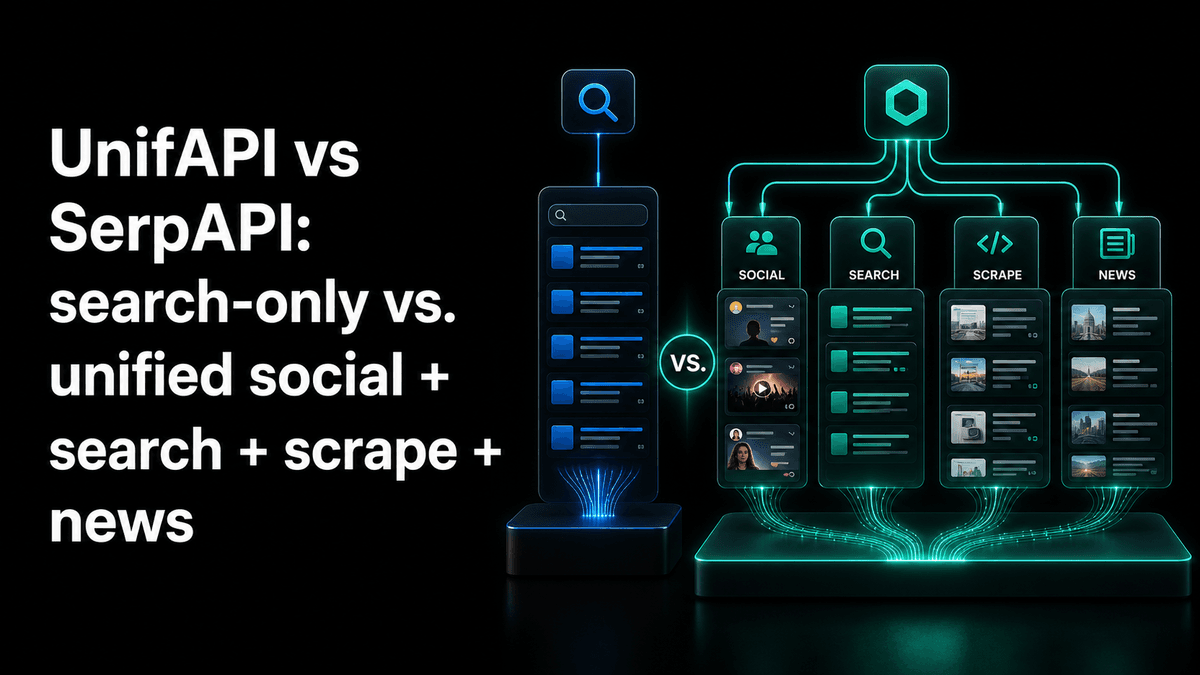
SerpAPI is a focused SERP wrapper; UnifAPI is a Skill-first public social data layer for creator research, KOL pricing and competitive intel.
In short: This comparison is for agents that need search results sometimes but platform-native social records for creator research, monitoring, and competitive intelligence.
SerpAPI is a search-engine specialist: it wraps search results behind a tidy JSON shape and has been a default SERP API for years. UnifAPI is different today: the live surface is public social data plus MCP Skills for tasks like KOL pricing, creator research, social listening, and competitive intelligence. If your agent only ever needs search results, a SERP specialist is excellent. If it needs public social records and agent-native workflows, the decision changes.
What SerpAPI does well
SerpAPI is narrow on purpose. Google SERP scraping is hard — the page shape changes constantly, geo-targeting matters, knowledge panels and featured snippets need parsing — and a focused team has been polishing that one slice for years. The result is one of the most reliable SERP wrappers on the market, with structured outputs for organic results, ads, knowledge graphs, related searches, and the long tail of Google features.
If your agent's value is entirely about Google results — rank tracking, SERP feature monitoring, position-on-keyword analytics — SerpAPI is mature and dependable.
Where SerpAPI ends, UnifAPI begins
Most agents don't stay inside Google. They land on a SERP, then they want to read the actual tweet, watch the YouTube video the result links to, pull the Reddit thread, hit the LinkedIn profile, or scrape the article. Each of those is a separate integration on SerpAPI's side — you have to leave it.
UnifAPI is the version where the social-data half does not become a pile of wrappers. The catalog covers live public-data APIs today: TikTok, LinkedIn, Instagram, YouTube, Twitter/X, Threads, Reddit, and Hacker News. Generic search and URL-fetch APIs are intentionally outside the catalog because Codex and Claude Code already include those primitives.
Pricing comparison
SERP tools usually price around search volume. UnifAPI prices the public-data layer with $0.001 operation credits, separate from the agent plan you already use. A standard creator-research run that pulls 50 public social records costs $0.05 in data calls.
For pure SERP workloads, use a search specialist. For mixed creator, social-listening, KOL-pricing, and competitive-intelligence workflows, UnifAPI's flat record pricing and MCP Skills avoid the multi-vendor billing tax.
Migration path
If you've already built on SerpAPI, keep it for Google. Add UnifAPI when the workflow moves into public social evidence: creator profiles, posts, comments, channels, communities, and trend signals that a Skill can summarize.
Pick SerpAPI if Google is the entire product. Pick UnifAPI if the agent needs public social data, KOL pricing, creator discovery, social listening, or competitor monitoring.
See UnifAPI Skills at unifapi.com/skills, the live public-data catalog at unifapi.com/apis, the per-record pricing at unifapi.com/pricing, or the MCP setup at unifapi.com/mcp.
What to read next
UnifAPI vs Exa - compares another search-first data layer.
Public TikTok, Instagram, and YouTube data - shows what platform-native records look like in practice.
Compare alternatives - keeps the vendor decision tree together.