
UnifAPI vs Exa: platform-native public data vs. neural web search

Updated
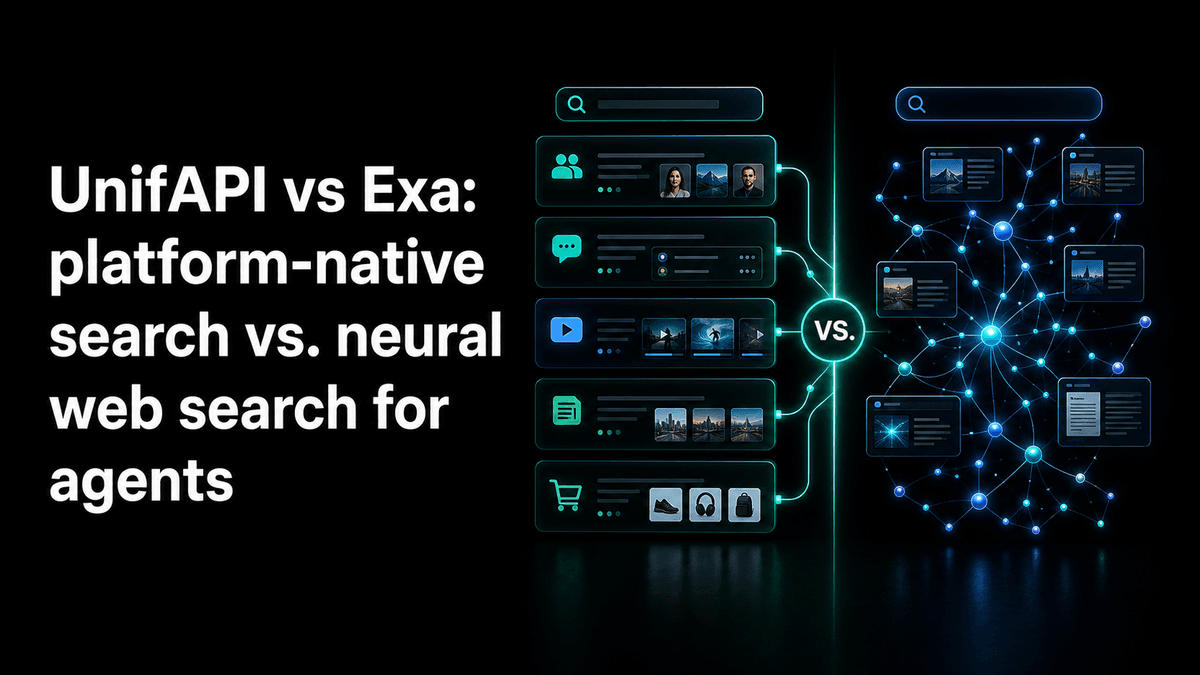
Exa is neural web search; UnifAPI gives agents platform-native public records and Skills for creator research, KOL pricing and social listening.
In short: This comparison clarifies the search-versus-records decision: Exa finds semantically relevant pages, while UnifAPI returns platform-native public records.
Exa is a neural-embedding search engine that indexes the open web and answers semantic queries ("find me content conceptually similar to X"). UnifAPI exposes platform-native public records — TikTok search, Reddit feeds, YouTube search, LinkedIn search — that return the platform's own ranked results in a unified shape. They solve adjacent problems: Exa picks URLs, UnifAPI picks records on a specific platform.
What each one is
Exa (formerly Metaphor) is the AI-native search incumbent: it crawls the open web, builds a neural index, and exposes a single search endpoint that returns conceptually-relevant URLs plus extracted page content. The win condition is "find pages I would have struggled to find with keyword search" — and it does that well enough that Cursor's @web feature is powered by Exa.
UnifAPI ships platform-native search and feed endpoints, not one whole-web index. A query against /tiktok/search hits TikTok's own ranking surface and returns videos with platform metadata (hashtags, like counts, creator handles). A call to /reddit/feed/popular or /reddit/feed/news returns posts with subreddit, score, and comment count. The platform's own ranking is the feature, not a bug.
Discovery semantics: neural vs. platform-native
Exa answers questions like "find articles about LLM context-window scaling techniques." The query is conceptual, the corpus is the open web, the result is a ranked list of URLs whose embeddings sit close to the query embedding. Excellent for research-style agents and RAG ingestion.
UnifAPI answers questions like "find TikTok videos tagged #anthropic posted this week" or "monitor current Reddit popular/news threads mentioning context windows." The query is platform-specific, the corpus is the platform's catalog, the result is records with all the platform's structured metadata. Excellent for social listening, brand monitoring, and platform-bounded research.
Pricing comparison
Neural search tools usually price around searches, contents, or research modes. UnifAPI prices public-data operations in credits: standard records are one $0.001 credit each, and higher-cost operations publish their minimum credits from OpenAPI. A standard search call that returns 20 TikTok videos is 20 credits ($0.02), and the model execution stays inside the agent product you already use.
The math depends on result-count distribution. The durable distinction is unit of work: Exa finds web pages; UnifAPI returns platform-native records that a Skill can compare, rank, enrich, and revisit.
When Exa wins
Pick Exa if your agent's job is to find conceptually-relevant pages from anywhere on the open web — RAG ingestion, deep-research workflows, "give me articles about X" prompts. Exa's neural index is unmatched for queries that don't map to a specific keyword or platform.
When UnifAPI wins
Pick UnifAPI if your agent needs platform-specific data — social signal, hashtag tracking, creator research, subreddit monitoring, LinkedIn lookups. Neural search over the whole web can find a relevant tweet, but it can't tell you the like count, the reply tree, or the most-recent posts from that creator. Platform-native endpoints can.
Using both
A research agent that combines them works well: Exa picks conceptually relevant URLs across the open web, UnifAPI fans out to enrich platform URLs with native records such as YouTube metadata, Reddit comment trees, or TikTok creator history. They don't compete for the same slot; they answer different questions.
Browse UnifAPI Skills at unifapi.com/skills, inspect the catalog at unifapi.com/apis, see per-record pricing at unifapi.com/pricing, or wire the MCP server alongside search tools at unifapi.com/mcp.
What to read next
UnifAPI vs Firecrawl / Tavily - continues the page-reader comparison lane.
Public TikTok, Instagram, and YouTube data - shows platform-native records in a workflow.
Compare alternatives - groups the full vendor comparison set.