
UnifAPI vs Composio: public-data Skills vs. user OAuth tools

Updated
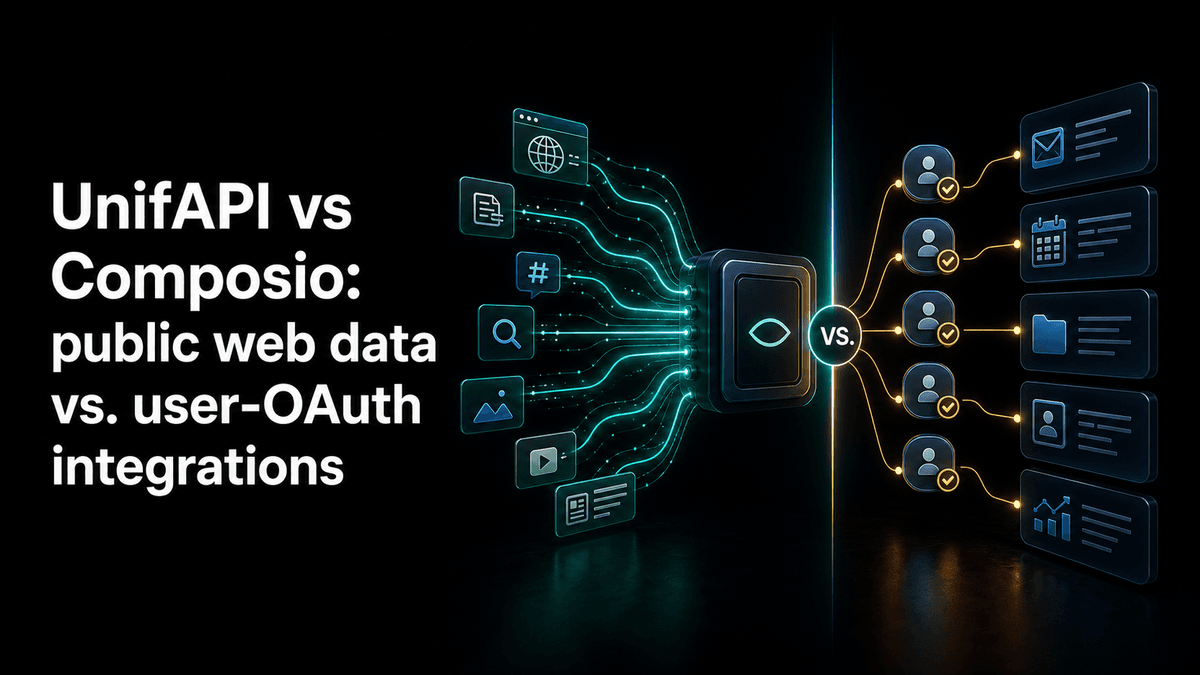
Composio connects agents to a user's own SaaS via OAuth. UnifAPI gives agents public-data Skills through MCP. The two halves of agent integration.
In short: This article is for readers comparing public-data access with user-authorized SaaS tools: Composio handles private account OAuth, UnifAPI handles public evidence.
Composio and UnifAPI are two halves of the agent-integration story, not a simple replacement pair. Composio connects agents to data the end user owns — Gmail, Notion, Linear, Salesforce — via OAuth. UnifAPI gives agents task-specific Skills over public data — TikTok, Reddit, YouTube, Twitter/X, LinkedIn, and Instagram — through MCP and one shared billing layer. Most production agents use both, in different lanes.
The two halves of agent data access
Agent integrations split cleanly into two categories. Personal data: things only the end user can authorize access to — their inbox, their CRM, their calendar. Public data: things anyone with a browser could read — posts, comments, public profiles, videos, channels, and communities.
Personal data needs OAuth per user, encrypted token storage, refresh logic, scope management, and a way to gracefully handle expired or revoked permissions. Public data needs none of that — it needs one MCP connection, one bill, and a clean shape.
How Composio works
Composio is the integration layer for the personal-data half. It maintains OAuth apps with hundreds of SaaS providers (Gmail, Slack, GitHub, Notion, Linear, HubSpot, Salesforce), brokers user consent flows, stores tokens, and exposes a normalized tool surface to the agent. Your agent doesn't see refresh-token logic — it sees a list of callable tools scoped to the user it's running for.
If your agent reads or writes inside a user's own accounts — drafting their emails, creating their Linear tickets, updating their CRM — Composio is built for that.
How UnifAPI works
UnifAPI is the integration layer for the public-data half. It maintains source clients for live public-data APIs (TikTok, LinkedIn, Instagram, YouTube, Twitter/X, Threads, Reddit, and Hacker News), normalizes their responses into one envelope, and exposes the catalog as both HTTP endpoints and MCP tools.
If your agent reads public social data — pulling tweets about a topic, finding YouTube videos, ranking creators, pricing KOLs, or summarizing Reddit threads — UnifAPI is built for that.
Side-by-side: use case by use case
"Draft an email reply summarizing the last 5 messages in this thread" → Composio. The data lives in the user's Gmail.
"Find what TikTok creators are saying about our product launch this week" → UnifAPI. The data is public.
"Create a Linear ticket from the support email I just got" → Composio.
"Pull the top 10 Reddit threads about a competitor and summarize sentiment" → UnifAPI.
"Look up the calendar invite the user sent yesterday" → Composio.
"Find public posts and threads mentioning our brand this week" → UnifAPI.
Using them together
Real agents typically need both. A go-to-market agent might use UnifAPI to monitor brand mentions on Reddit and TikTok, then use Composio to push relevant ones into the user's Linear board as tickets. A research agent might use UnifAPI to gather web evidence and Composio to file the findings into the user's Notion workspace.
There's no overlap. Pick Composio for the OAuth half, pick UnifAPI for the public-web half, and let them stay in their lanes.
Browse Skills at unifapi.com/skills, inspect the public-data catalog at unifapi.com/apis, or wire the MCP server in three minutes at unifapi.com/mcp.
What to read next
Connect UnifAPI MCP - shows how the public-data half connects to agent clients.
Minimum viable agent stack - places UnifAPI and OAuth connectors in the same architecture.
MCP setup - documents the UnifAPI connector path.