
UnifAPI vs Browserbase / Stagehand: public-data Skills vs. browser agents

Updated
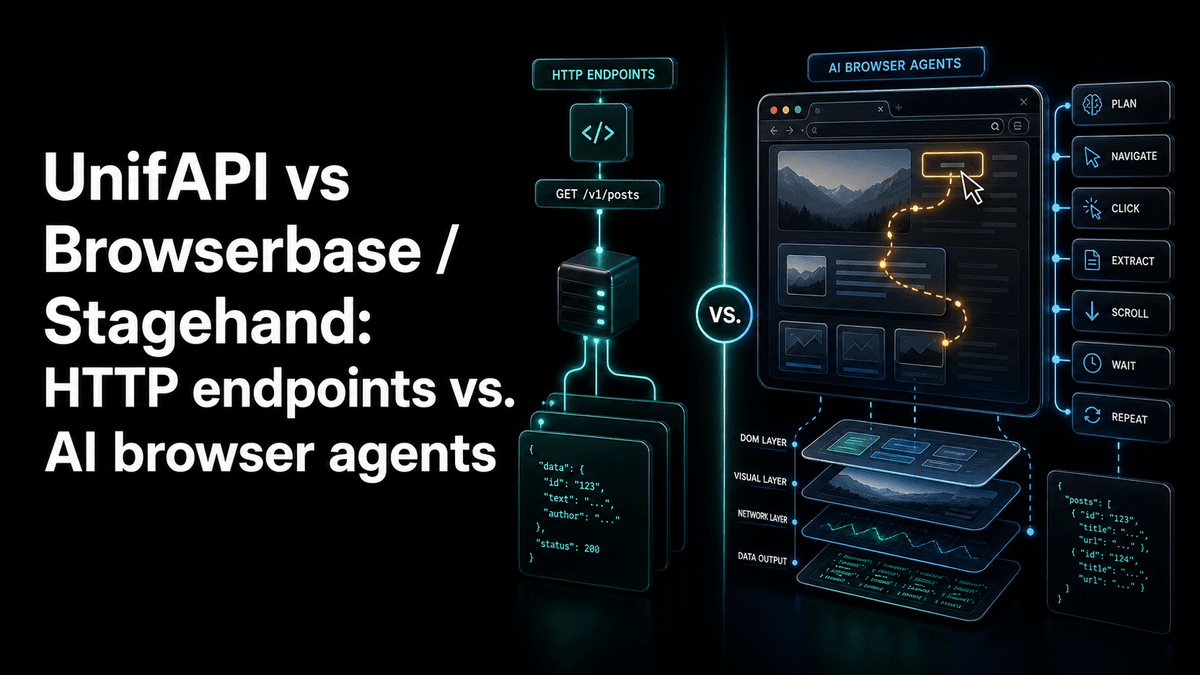
Browserbase + Stagehand drive agents through websites. UnifAPI gives agents public-data Skills and HTTP records. Pick by whether the task needs a browser.
In short: This comparison draws the browser boundary: use Browserbase or Stagehand when the website must be operated, and UnifAPI when public records are enough.
Browserbase is managed headless-browser infrastructure for AI agents; Stagehand is its open-source automation framework that turns natural-language instructions into browser actions. Together they're the right answer for login-walled, JS-heavy, or interactive workflows. UnifAPI is Skills and HTTP endpoints for public data — no browser, no session, no provider login. The line between them is the access boundary, not the platform list.
What each one is
Browserbase rents you a managed headless browser via API, complete with proxies, captcha solving, session replay, and prompt observability. Stagehand sits on top: an SDK where you write code like page.act("click the sign-in button") and Stagehand translates that into the right DOM operations using an LLM. Together they're the production stack for AI agents that have to drive a browser like a human would.
UnifAPI is the layer below the browser. A call to /reddit/feed/popular or /reddit/posts/{id}/comments hits Reddit's data tier directly and returns structured JSON. There's no DOM, no JS execution, no rendering, no flaky selectors. The trade is that UnifAPI only sees what the public platform makes available — anything behind a login is out of scope.
The access boundary
If the data your agent needs requires a logged-in session — your user's Gmail inbox, their HubSpot dashboard, their bank statements, a competitor's private analytics page — you need a browser agent. Browserbase + Stagehand are built for this. The agent logs in (with the user's credentials, scoped to the session), navigates, extracts, and returns. The browser is the boundary.
If the data is public — tweets, public Reddit threads, public profiles, comments, channels, and YouTube videos — a browser is often overkill. You're paying for compute, latency, and complexity you don't need. UnifAPI hits the platform's data tier directly. Same category of public evidence, lower cost, lower latency, no UI flakiness.
Pricing model
Browser stacks usually price around browser hours, sessions, steps, or compute. UnifAPI prices returned public-data records at $0.001 each, with no separate LLM execution charge on our side. The models are incomparable on purpose: browser time is the right unit for operating websites; records are the right unit for direct public-data calls.
Latency and reliability
Browser agents are slower and more brittle by physics rather than design. A session has to open pages, wait for rendering, click, and extract. Selectors break when the UI shifts; LLM-driven actions recover gracefully but still cost tokens. Reliability is the engineering challenge of the entire category.
HTTP API calls return predictable JSON and don't break when a platform rewrites its CSS. Reliability comes from one place: the gateway's reshape layer.
When Browserbase / Stagehand wins
Pick Browserbase + Stagehand when the data is behind a login, behind aggressive JS, or behind a multi-step interactive flow. "Sign into the user's CRM and pull this week's deals," "log into the airline portal and rebook the cancelled flight," "navigate the SaaS dashboard the user just connected" — all browser-agent territory.
When UnifAPI wins
Pick UnifAPI when the data is public and you'd rather not operate a browser stack. Public social platforms are behind MCP and HTTP endpoints with one shape and $0.001-per-record pricing. Browse Skills at unifapi.com/skills, the live catalog at unifapi.com/apis, and MCP setup at unifapi.com/mcp.
Using both
Production agents typically draw the line where authentication starts. UnifAPI for public social evidence and Skills such as KOL pricing or social listening, Browserbase + Stagehand for the OAuth-or-login-walled half that needs to operate a website. The two don't overlap and don't compete; they meet at the auth boundary and stay there.
What to read next
UnifAPI vs TinyFish - applies the same browser-agent boundary to another vendor lane.
UnifAPI vs Apify / Bright Data - compares the lower-level scraping layer.
Minimum viable agent stack - shows where browser agents and public-data APIs can coexist.