
UnifAPI vs Apify / Bright Data: agent Skills vs. scraping platforms

Updated
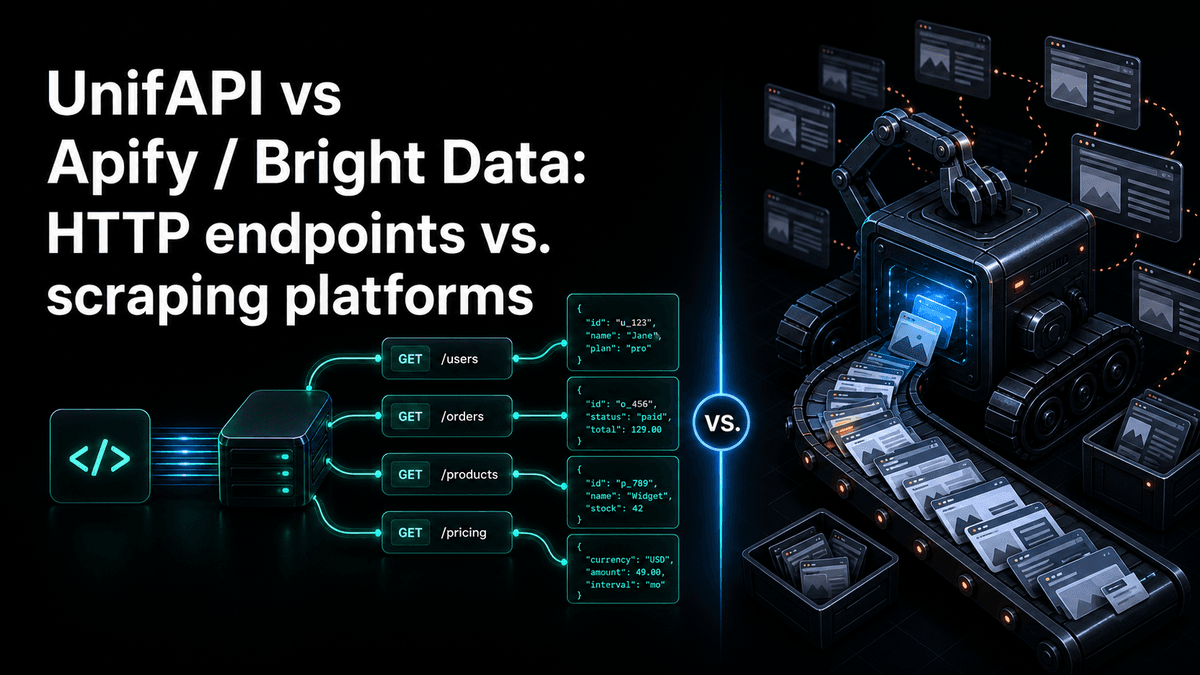
Apify and Bright Data sell scraping infrastructure; UnifAPI sells task-ready public-data Skills and finished endpoints. Pick the right abstraction.
In short: This comparison helps teams decide whether they need scraping infrastructure or a finished public-data API layer for agent-readable records.
Apify and Bright Data are scraping platforms: they sell the underlying infrastructure — proxies, browser farms, actor runtimes, dataset storage — that you compose into a scrape. UnifAPI is Skills-first for agents and API-ready for builders: it sells finished public-data results with predictable JSON and $0.001 operation credits. The right choice depends on whether you want to operate the scraping layer or let an agent consume the result of it.
What each one is
Apify is a marketplace of pre-built scraper actors plus a hosting platform for ones you write yourself. You pick an actor, configure inputs, run it, and receive a dataset. Bright Data is closer to the metal: a proxy network, a browser-based unblocker, and ready-made datasets for the largest platforms. Both expose an SDK and pay-as-you-go billing for compute and data.
UnifAPI is the layer above either of those. There are no actors to configure, no proxies to rent, no datasets to schedule. A Skill can ask for creator research or social listening, call UnifAPI MCP when it needs evidence, and receive JSON records. Developers can call the same operations over HTTP when the workflow becomes product code.
Time-to-first-record
On Apify or Bright Data, time-to-first-record is the time it takes to pick the right actor, configure its inputs, kick off the run, and parse the resulting dataset. For a familiar platform that's minutes; for a new one, it's a half-day of reading actor docs.
On UnifAPI, time-to-first-record is one agent action: connect https://mcp.unifapi.com, authenticate when the tool call needs credits, and ask for the output. The live platforms are documented consistently — if the agent can inspect one operation, it can inspect the catalog.
What you maintain
Apify and Bright Data give you levers: pick an actor version, tune proxies for a region, retry a failed run, re-schedule. The flip side is that you own the integration when the source changes shape, and you own the alerting when an actor goes red.
UnifAPI hides those levers and owns the maintenance. When a platform changes a field name, we catch it in our reshape layer and ship the fix. Your agent code keeps working without a redeploy. The trade is that you give up the fine-grained control — you can't pick a Brazilian proxy IP for one call.
Pricing model
Apify bills compute units plus dataset storage; Bright Data bills bandwidth, residential-proxy minutes, or dataset rows. Both are predictable for steady workloads and confusing for new ones — usage estimation takes a few runs to dial in.
UnifAPI is flat $0.001 per returned public-data record. One unit, one rate: a social-listening call that returns 10 records costs $0.01, and a 50-record creator research page costs $0.05. The bill matches what your agent actually consumed.
When to pick which
Pick Apify or Bright Data if your team has scraping depth, you need fine-grained control over the scraping layer (custom selectors, residential geos, scheduled crawls of millions of pages), or your target site isn't in any agent-API catalog.
Pick UnifAPI if you want public-data inputs to your agent without operating a scraping stack — live public-data APIs behind one MCP server, one bill, and Skills that start from task outcomes. You can always layer in a scraping platform later if a workload needs lower-level control.
Start with Skills at unifapi.com/skills, the live catalog at unifapi.com/apis, pricing at unifapi.com/pricing, and MCP setup at unifapi.com/mcp.
What to read next
Unified response envelope - explains what UnifAPI standardizes after source collection.
UnifAPI vs Browserbase / Stagehand - draws the adjacent browser-agent boundary.
Live API catalog - shows the shipped records available without actor setup.