
Give agents public TikTok, Instagram, and YouTube data through Skills

Updated
Use public TikTok, Instagram and YouTube records in creator-research and social-listening Skills — through MCP first, HTTP when you productize.
In short: This cookbook targets implementation-stage readers who need TikTok, Instagram, and YouTube records for creator research or social listening without building three integrations.
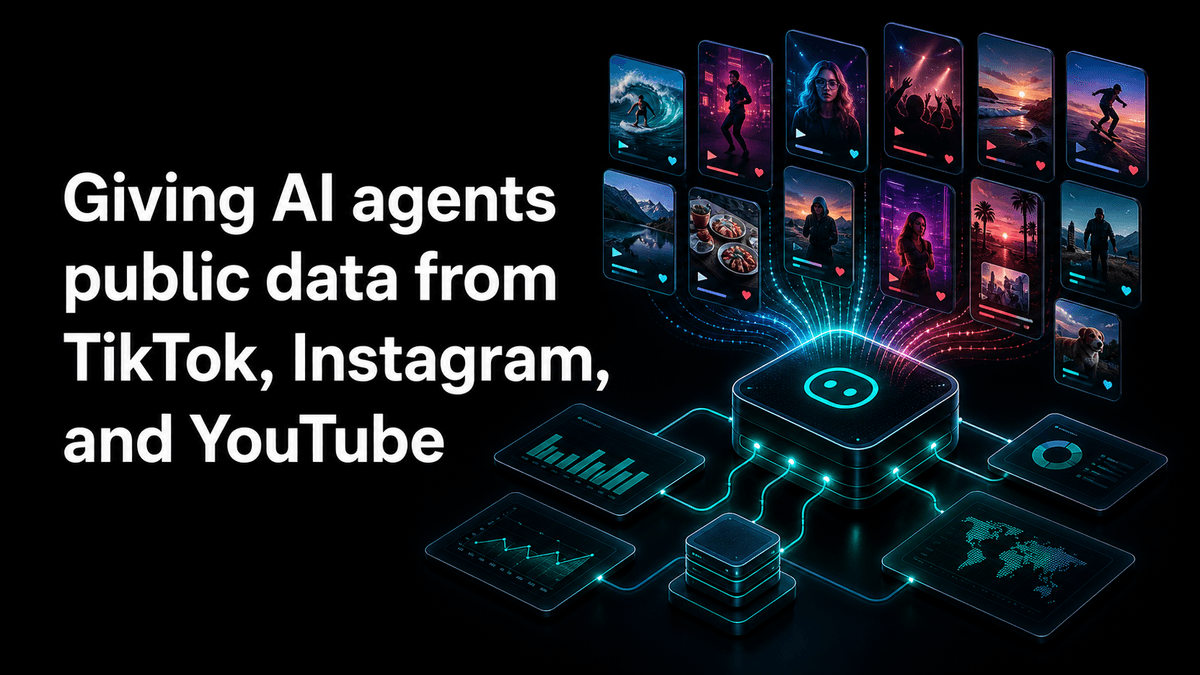
UnifAPI exposes TikTok, Instagram, and YouTube public data through a shared MCP and HTTP surface priced with $0.001 credits. This guide frames the common primitives, pagination, and cost math so an agent can run creator-research and social-listening Skills without a custom GUI.
Most consumer-facing public-data workflows — brand monitoring, creator research, product launch analysis, trend detection — bottom out in the same three platforms: TikTok for short video, Instagram for visual social, YouTube for long-form. Building a stable feed from all three has historically meant three vendor contracts and three different envelopes. With UnifAPI it is one MCP server and one shape across the lot.
Which endpoints you actually need
For most agent workflows, three primitives are enough per platform: search by keyword or hashtag, fetch a single post or video by ID, and list recent posts from a creator. Anything else — comments, related posts, follower context — is supporting detail the agent can fan out to once the primary set is in hand.
On UnifAPI, those map to: TikTok — /tiktok/search, /tiktok/videos/{id}, /tiktok/users/{id}/videos. YouTube — /youtube/search, /youtube/videos/{video_id}, /youtube/channels/{channel_id}/videos. Instagram — /instagram/search, /instagram/posts/{shortcode}, /instagram/users/{username}/posts. Naming intentionally lines up across platforms so the agent prompt that learned one learned all three.
The unified request shape
Every HTTP endpoint accepts the same Authorization: Bearer <key> header and returns the same outer envelope: { request_id, data, pagination?, billing }. The fields inside data are platform-specific (a TikTok video has a hashtag list, a YouTube video has channel metadata), but the shape around it is consistent.
That uniformity matters more than it sounds. It means your agent's tool-use loop has one retry policy, one pagination handler, one error envelope — not three. The platform-specific knowledge stays inside the data field, where the model can see it.
Pagination across three platforms
Each platform paginates differently — TikTok uses a cursor token, YouTube uses pageToken, Instagram uses end_cursor. UnifAPI normalizes those signals to a single { cursor, has_more } object. Your agent loop reads the cursor, passes it back as the cursor query parameter on the next call, and stops when has_more flips to false.
Default page size is 20 records on every platform. The cap is 50. For most agent runs, one page is enough — the model rarely needs more than the top 20 hits to make a decision.
Estimating cost per agent run
Cost is records × $0.001. A "monitor TikTok mentions of our brand this week" run that pulls 20 search results, then fans out to fetch 5 individual videos for transcripts, is 25 records — $0.025. A "creator research on this account" run that pulls 50 recent posts and 10 video details is 60 records — $0.06.
A back-of-envelope rule that's served us well: budget $0.05 per agent run for typical research workflows, $0.20 for deep dives. The one-time 2,000-credit first top-up bonus alone covers roughly forty light runs.
Putting it together
An end-to-end "find what's trending about us this week across all three" agent looks like: parallel-call /tiktok/search, /instagram/search, /youtube/search with the brand keyword; collect the top 10 from each; for the top 3 of each platform, fan out to /tiktok/videos/{id}, /instagram/posts/{shortcode}, or /youtube/videos/{video_id} for the full transcript or caption; pass the lot to the model with a summarization prompt.
Total cost: 30 search records + 9 detail lookups = 45 credits, $0.045 — each of the three Instagram post lookups bills the 3-credit per-call minimum published in the OpenAPI contract. Total integration count: one. That's the pitch — start from a Skill, connect the MCP server at https://mcp.unifapi.com, and sign in only when OAuth is needed for tool calls and workspace credits.
What to read next
Run a KOL pricing agent with MCP - uses these platforms as creator-pricing enrichment.
Unified response envelope - explains how multi-platform responses stay comparable.
API catalog - lists the live platform operations.