
The minimum viable agent stack for public data Skills

Updated
A practical architecture guide for public-data Skills: agent client, MCP runtime, unified data layer, observability, cost controls, and failure boundaries.
In short: This architecture piece is the hub for teams turning chat-thread Skills into durable products: agent client, MCP runtime, public-data layer, and observability.
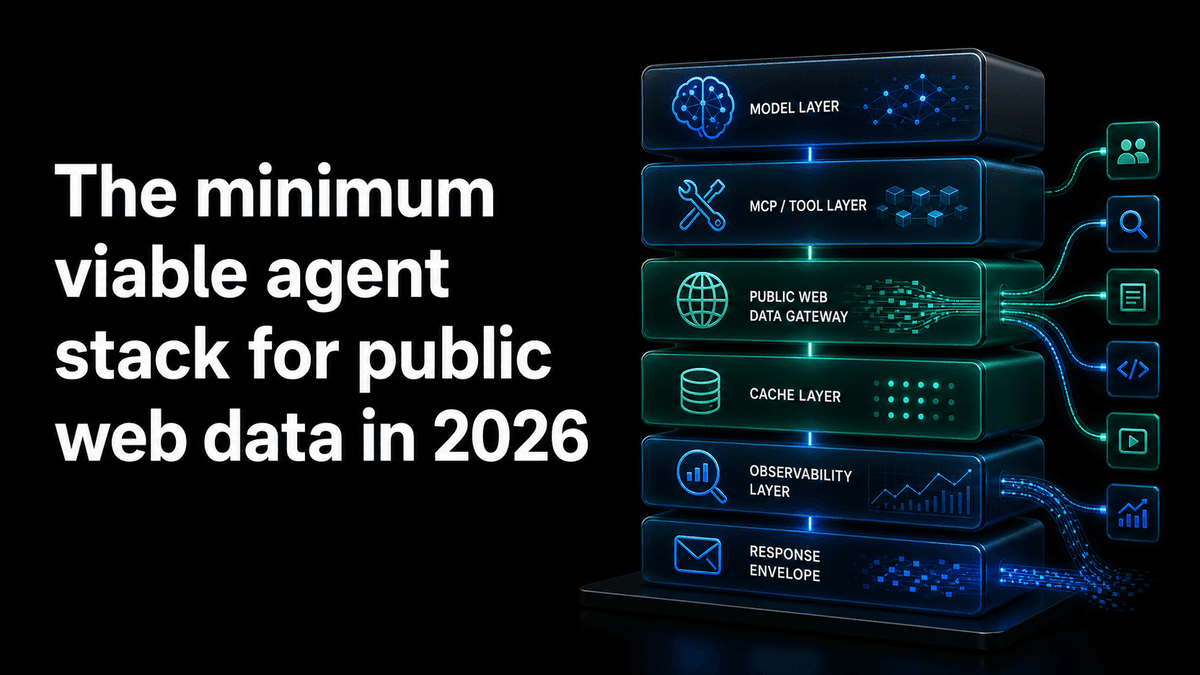
Building a production workflow that reaches for public data needs four pieces and a few guardrails: an agent product that is good at tool use, an MCP runtime, a unified public-data layer, observability over what the agent actually called, and controls that keep cost and scope inspectable. Everything beyond that should earn its place.
This is the stack we would keep for public-data Skills such as KOL pricing, creator discovery, social listening, competitive intelligence, and market research. It is intentionally smaller than a full agent platform diagram because most teams overbuild the first version.
The reference stack
| Layer | Development choice | Production choice | What it must prove |
|---|---|---|---|
| Agent product | Claude, ChatGPT custom MCP apps, OpenClaw, Hermes, Codex, Claude Code, Cursor, VS Code | The agent runtime your team already trusts | Can call tools, inspect results, and revise output |
| MCP runtime | Hosted MCP URL in the client | Long-lived MCP-capable agent service | Stable auth, tool discovery, tool execution |
| Public-data layer | UnifAPI MCP and HTTP APIs | Same, with explicit scopes and budgets | One envelope, one billing model, live public records |
| Observability | Browser/client transcript plus logs | Tool-call traces, record counts, latency, cost | Can replay why the answer changed |
| Persistence | Copy the result manually | Store run inputs, record IDs, outputs, and decisions | Can compare runs over time |
The first four layers are required. Persistence becomes required once the workflow is repeated or customer-facing. Until then, the fastest learning loop is usually an agent thread plus a clear Skill prompt.
Layer 1: the agent product
The model picks tools; the runtime executes them. Modern agent products can handle multi-step tool use without much prompting if the task and tool surface are clear. For development, use the product your team already lives in: Codex for repo-native work, Claude Code for terminal and project automation, Claude Desktop or Claude.ai for operator workflows, Cursor when the work starts in the editor.
Do not start by building a custom GUI unless the workflow already has stable inputs and a repeated buyer. A GUI freezes the workflow too early. A Skill lets the operator ask follow-up questions, change the target market, request a deeper search, or ask the agent to explain confidence before productizing anything.
Layer 2: MCP runtime
MCP is the connection layer between the agent and external systems. For public-data Skills, the runtime needs to expose tools, handle OAuth or bearer authentication, show connection status, and let the agent inspect available operations.
Remote HTTP MCP servers are now the default shape for cloud-hosted services in the major agent clients we checked. Claude Code's reference calls HTTP the recommended option for remote cloud servers where available. Cursor documents Streamable HTTP as a remote transport with OAuth. OpenAI's Docs MCP page shows Codex adding a Streamable HTTP MCP server by URL.
For UnifAPI, that means the Skill should not ask the user to install a local scraper or paste platform API keys. It should ask them to connect https://mcp.unifapi.com, authenticate with OAuth when needed, and let the agent discover operations through the MCP catalog.
Layer 3: unified public-data layer
The unified data API is the single biggest leverage point in this stack. If your agent ends up calling one wrapper for Twitter/X, another for Reddit, another for YouTube, and a spreadsheet for KOL pricing, you have built a multi-vendor integration problem before you have built the agent workflow.
Push that complexity behind one gateway. UnifAPI's live catalog covers TikTok, LinkedIn, Instagram, YouTube, Twitter/X, Threads, Reddit, and Hacker News behind one MCP server and one HTTP contract. The agent prompt becomes 'run the KOL pricing Skill' rather than 'call profile_api, comments_api, search_api, then stitch a spreadsheet.'
The key product requirement is not just coverage. It is consistent response behavior: predictable request ids, a data payload, optional pagination, billing metadata, and normalized errors. Those details are what let the agent recover from partial failure instead of inventing a story.
Layer 4: observability and replay
Without observability you debug blind. The bare minimum for a production public-data agent is a trace per run that records the user prompt, every tool call, arguments, response status, duration, returned record count, billed record count, model output, and final decision.
Once you can replay a run, regressions stop being mysterious. A slow run is usually one of four things: model latency, public-source latency, a prompt that fans out too broadly, or a retry loop caused by ambiguous operation selection. The trace should tell you which one it was.
| What to log | Why it matters |
|---|---|
| Original user task | Explains intent and constraints |
| Operation selected | Shows whether discovery picked the right source |
| Query/body args | Explains why a source returned those records |
| Record count and billing | Makes cost predictable |
| Pagination decisions | Shows whether the run stopped too early or too late |
| Confidence and assumptions | Keeps the final answer auditable |
Layer 5: persistence
Do not persist everything on day one. Persist the minimum facts that let a future user understand or compare the decision. For a KOL pricing run, store the campaign input, creator handles, public record IDs or URLs, estimated ranges, confidence, assumptions, and final notes. For social listening, store query, source, time window, top records, themes, and a summary.
The trap is saving raw tool output without saving the decision context. A future reader needs to know why the agent fetched those records and what the answer was supposed to help decide.
Cost controls
Public-data agents need explicit cost controls because tool use can fan out quickly. A good Skill sets a default record budget, explains what a light run costs, and asks before moving from screening to deep research.
| Control | Default for a first version |
|---|---|
| Record cap | 20-50 records per source before asking to continue |
| Platform scope | Start with the primary platform, enrich only when needed |
| Pagination | Stop when marginal records stop changing the answer |
| Deep dives | Require explicit user confirmation for multi-source expansion |
| Output | Return evidence and assumptions so the user can decide if more data is worth it |
Where this stack still fails
First, OAuth into the user's own SaaS accounts is a different integration category. Gmail, Linear, Notion, HubSpot, and Salesforce are user-authorized private data. UnifAPI is for public data. Use a connector platform or a second MCP server for the user's private systems.
Second, long-running background workflows need orchestration outside the chat thread. A weekly digest, overnight crawl, or hourly monitor should use a scheduler, durable queue, and notification path. The Skill can define the task shape, but production delivery needs an execution layer.
Third, browser workflows are still necessary when the website itself is the interface. If the agent must log into a portal, fill a form, or navigate a dashboard, use a browser-agent stack. If the agent needs repeatable public records, start with APIs.
A build order that keeps you honest
Start with one Skill in one agent client. Add UnifAPI MCP. Run five real tasks by hand. Inspect the records and final outputs. Add a cost cap. Add trace logging. Only then productize the workflow behind an app UI or scheduled job.
The order matters because it prevents premature infrastructure. If the Skill cannot produce a useful answer in a transparent agent thread, a nicer UI will not fix it. If it can produce a useful answer in a thread, the productization path becomes much clearer.
Sources checked
This architecture guide was refreshed on June 2, 2026 against the official Model Context Protocol introduction, OpenAI Docs MCP page, Claude Code MCP reference, and Cursor's MCP documentation.
What to read next
MCP catalog tool design - dives into the MCP operation layer.
Unified response envelope - covers the data contract the stack depends on.
Agent First public-data Skills - connects the architecture back to user-facing Skills.